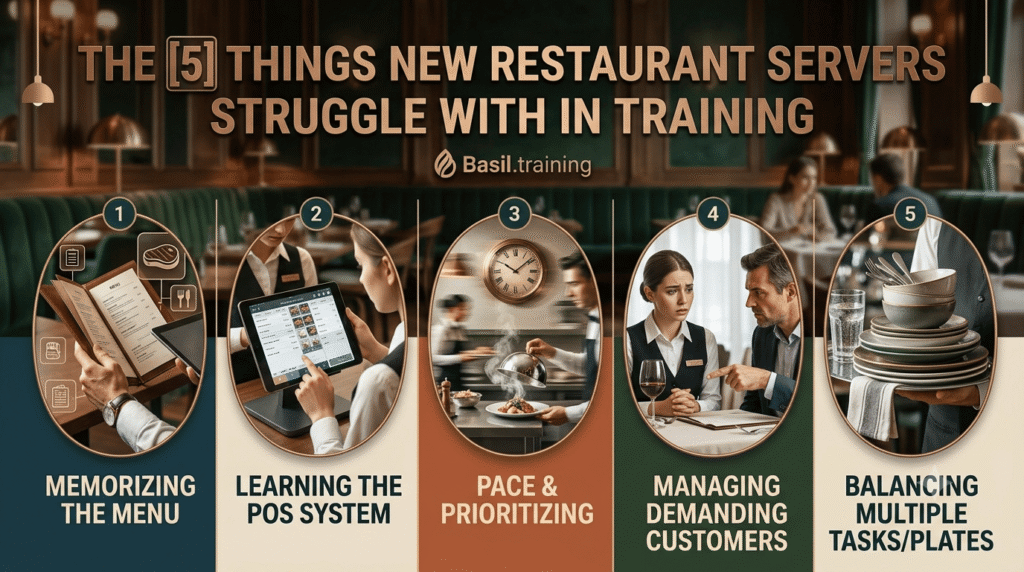
The five things new front-of-house staff actually struggle with
Most restaurant onboarding problems are structural. But two of the five are language problems wearing an operations costume — and those are the ones that get misdiagnosed as attitude.
Restaurant turnover is not news. What is worth looking at is when people leave, because the timing points straight at the cause.
US Bureau of Labor Statistics data puts annual turnover across accommodation and food services at 65.5% for 2025, and industry reporting consistently places front-of-house roles — servers, hosts, bartenders — around 41% a year. Replacement cost estimates cluster between $2,000 and $5,900 per hourly employee once recruiting, admin and lost productivity are counted.
The interesting number is the distribution. Roughly 20% of new-hire turnover happens inside the first 45 days, and close to 30% inside 90. Frontline analyses put the share even higher — between half and two-thirds of all frontline departures occur before the ninety-day mark.
People leave before the ninety-day review, which means they leave over training rather than over the job. Ask trainees what went wrong and the same five things come back.
1. Nobody agrees what “good” looks like
“Three people showed me three different ways to do it.”
Speed, upselling, greeting, closing — the standard is described verbally, differently, by whoever happens to be on. When service standards aren’t written down, every experienced server teaches their own version. The trainee doesn’t conclude that the restaurant is disorganised. They conclude that they are slow to learn. Designating a named trainer rather than “whoever’s on” is the standard fix, and inconsistency between trainers is a documented failure mode.
2. Everything arrives on day one
“I nodded through the whole orientation and remembered none of it.”
Policies, menu, POS, allergen procedure, table numbers, all in one session, with servers and dishwashers in the same generic room. There is no repetition and no visible progression from watching to doing to being signed off. Cognitive load research has a plain explanation for this: working memory holds only a few new items at a time, and information delivered above that ceiling is not stored badly — it is not stored at all.
3. The training happens during a busy shift
“I was on the floor on my second shift and told to keep up.”
Managers are time-poor, so training gets folded into live service. The trainee gets rushed explanations, almost no practice, and their first exposure to peak trade without a buffer. The cost isn’t just stress. Live service is the worst possible place to make a first attempt, because a first attempt is supposed to be allowed to fail.
4. The tools and the words
“I knew what the dish was. I couldn’t say it fast enough.”
POS flows, tip handling, table numbers, allergen rules, and the venue’s internal shorthand are covered once and rarely practised. For a non-native English speaker this compounds: the menu can be read, but not spoken about under pressure, and the allergen conversation — the one with real consequences — is the hardest one to hold.
5. After week one, nothing
“Nobody asked how it was going until my review.”
There is no 30-day check-in, only a 90-day probation meeting, which arrives after the fence-sitters have already gone. Feedback, when it comes, is vague: be faster, be more attentive. Nothing is tied to a specific standard, so nothing is actionable.
Two of these are language problems
Points 1, 2 and 5 are management-system problems. Write the standards down, name a trainer, stage the information, book a 30-day conversation. No software required.
Points 3 and 4 are different. They describe a skill that was never practised in a low-stakes setting before being performed in a high-stakes one — and for a non-native English speaker, the skill in question is speech.
Why shadowing doesn’t produce speech
Shadowing an experienced server is presentation, not practice. The trainee watches a model, hears the correct version, and is then expected to reproduce it live. In language teaching this is present–practise–produce, and for adults who already have partial competence it is a poor fit: it spends time on what they can already do and leaves the actual gaps undiagnosed until a guest finds them.
The evidence for the alternative is unusually solid. Corrective feedback — a correction delivered at the moment of error, inside a real communicative attempt — has been meta-analysed repeatedly in classroom second-language research. Lyster and Saito’s 2010 meta-analysis of fifteen classroom studies found significant and durable effects on language development, and Li’s 2010 meta-analysis of thirty-three studies reached the same conclusion with effects that held at delayed post-test.
The structural point is that the correction has to land while the learner is still holding the sentence they got wrong. A note in a debrief an hour later is information. A correction mid-turn is learning.
That second attempt is the part most training skips, and it is the part that produces evidence. A single score tells a manager very little. The same server going from a failed allergen conversation to a clean one in the same sitting tells them something specific: the gap closed, and here is the turn where it closed.
What an operator can do on Monday
- Write down the three moments that matter. The greeting, the allergen question, the complaint. One page, one version, so every trainer teaches the same thing.
- Name the trainer. Not whoever is on. One person, for the whole trial period.
- Practise the hard conversations off the floor. Ten minutes of role-play before service beats an hour of shadowing during it — because the trainee speaks instead of watching.
- Correct at the point of failure, not at the end. Interrupt, give the correct phrasing, let them say it again immediately.
- Book the 30-day conversation. Before the 90-day review, and tied to specific standards rather than “be more attentive”.
Where Basil fits
Basil is built on the loop in that third diagram. Staff hold a spoken conversation with an AI guest about your menu — your dishes, your allergen data, your escalation policy. When something breaks, a coach character interrupts in the moment with the correction, and the server re-attempts on the next turn. Then they run the same scenario again and the manager sees the delta.
It doesn’t fix your rota, your written standards or your check-in schedule. It fixes points 3 and 4: it moves the first attempt off the floor, and it gets the allergen conversation practised before a guest asks.
A note on sources. The turnover and onboarding figures above are drawn from published industry data rather than anecdote, and the argument about corrective feedback comes from second-language acquisition research. Everything is listed below so you can check it.
Sources
- US Bureau of Labor Statistics, Job Openings and Labor Turnover Survey — accommodation and food services separations rate, 2025.
- Hotel Online, “Onboarding Is Where Retention Begins” (2026) — first-45-day and first-90-day departure shares.
- Nowsta and DailyPay 2026 turnover analyses — front-of-house 41% annual turnover; ~$5,864 average replacement cost.
- Katalyst, “Restaurant onboarding and training: the first 90 days” (2026) — designated-trainer and role-specific-path failure modes.
- Lyster, R. & Saito, K. (2010). “Oral feedback in classroom SLA: A meta-analysis.” Studies in Second Language Acquisition, 32, 265–302.
- Li, S. (2010). “The effectiveness of corrective feedback in SLA: A meta-analysis.” Language Learning, 60(2), 309–365.
- Lyster, R. & Ranta, L. (1997). “Corrective feedback and learner uptake.” Studies in Second Language Acquisition, 19, 37–66.